
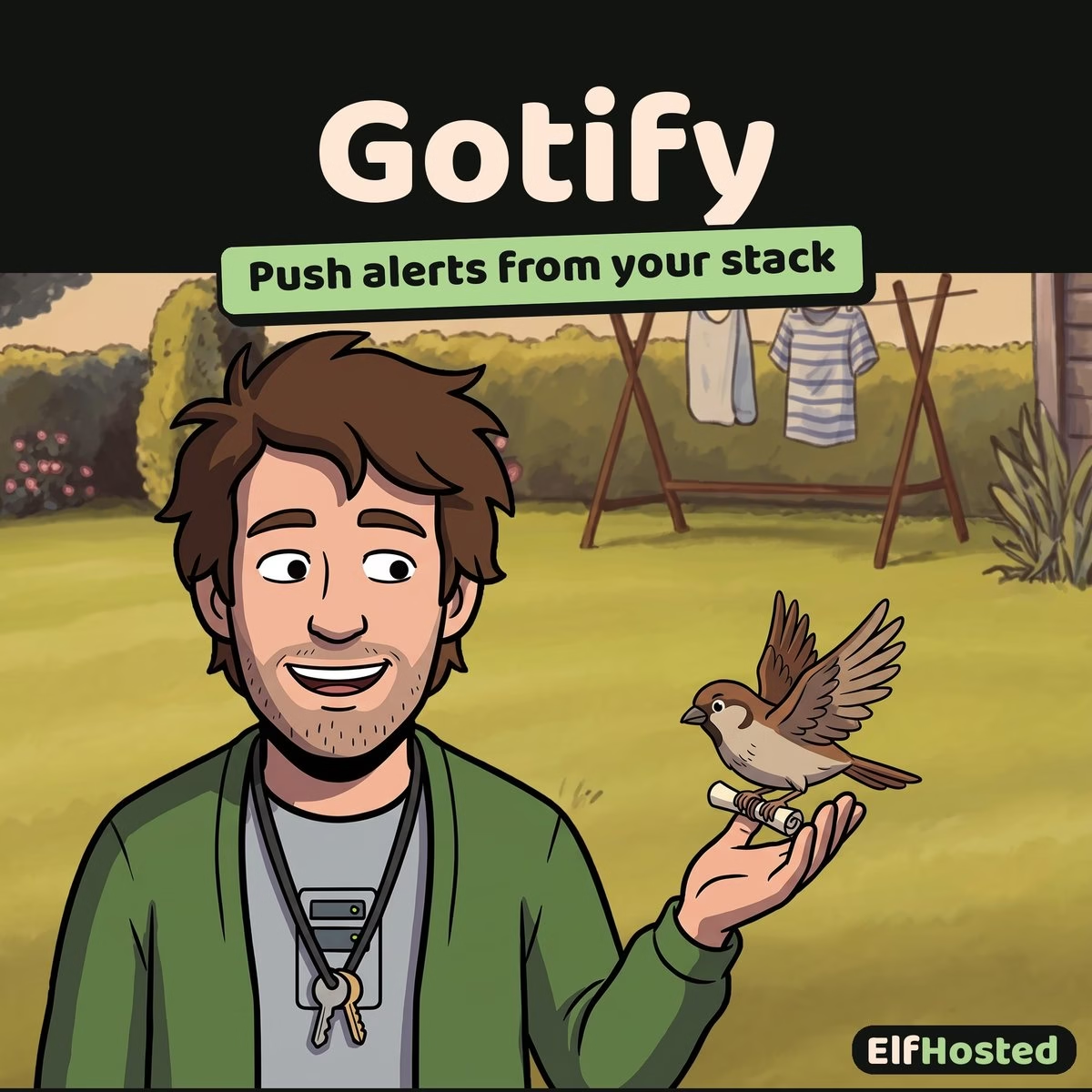


Gotify
From $1.29 / app / month
Self-hosted push notification server — your *arr stack, Uptime Kuma, Watchtower, and any webhook-capable tool fan out alerts to one Android app on your phone.
A managed instance of Gotify on ElfHosted — the self-hosted push notification server with native Android app, simple REST API, and broad ecosystem support. Most self-host tools (Uptime Kuma, the *arr stack, Watchtower, Home Assistant) speak Gotify out of the box. BSD-3 licensed; lightweight Go binary; works without a Google or Apple push-vendor account.
Included in every Flex plan. The from price is Flex Pro paid yearly, running 18 apps at once. Flex starts at $9.00 a month for 4 apps.
Pushover wants $5/year-and-a-tier-for-each-platform. ntfy is great. Gotify is the third option that's been quietly popular since 2018, with the simpler integration story for fan-out from your existing self-host stack.
What is Gotify?
Gotify is a self-hosted push notification server. The model is straightforward: applications push messages to your Gotify server via simple HTTP POST; the official Android app (or a third-party iOS app) receives them in real time via WebSocket and surfaces them as native notifications. No Firebase Cloud Messaging, no APNs, no Google or Apple push-vendor entanglement. Lightweight Go binary, SQLite or Postgres backend, BSD-3 licensed.
Most self-host tools support Gotify natively or via webhook. Sonarr / Radarr / Prowlarr / Bazarr / Lidarr / Readarr all have Gotify connectors built in. Uptime Kuma's notification list includes Gotify. Watchtower (Docker container update tool), Home Assistant, Authelia, Vaultwarden, the *arr ecosystem, and dozens more push to Gotify out of the box. The result: one app on your phone for all the "hey, this thing happened" alerts from your self-host stack.
Features
- 📲 Official Android app — open-source, on F-Droid and Play Store, persistent WebSocket connection for real-time delivery without Firebase battery drain.
- 📱 iOS via third-party clients — apps like UnifiedPush-compatible clients (Notify, NeoPush) work with Gotify; no official iOS app, but the WebSocket protocol is simple enough that several third-party clients exist.
- 🔔 Application-scoped tokens — each pushing app gets its own token; rotate / revoke per-source if a token leaks.
- 🎚️ Per-message priority — 0-10 scale; priority 8+ overrides Do Not Disturb on Android. Set high-priority for "service down" alerts, low for "new episode downloaded".
- 📋 Plugin system — extend with first-party plugins (Telegram bridge, NTFY bridge, RSS poller) or build your own in Go.
- 🔧 Simple REST API — POST a message with a per-app token to
/message?token=...; one HTTP call from any shell script, cron job, or programming language. Easiest-possible integration story. - 🌐 WebSocket streaming — clients connect over WebSocket; messages arrive in milliseconds.
- 👥 Multi-user — separate user accounts; each user gets their own apps and clients.
- 🔓 FOSS & BSD-3-licensed — no premium tier, no per-message billing, no ad-supported free plan.
Gotify vs Other Push Notification Options
- vs. Pushover — Pushover is the polished commercial competitor; one-time $5 per platform (Android, iOS, desktop). Pushover has the better iOS story (official app, polished); Gotify has the cheaper open-source story (no per-platform fee, runs anywhere, no vendor account). For Android-first users, Gotify is structurally cheaper and equivalent in features.
- vs. ntfy.sh — ntfy is the more recently-popular self-hosted notification server; topic-based subscription model (subscribe to a URL, anyone with the URL can publish). Different model from Gotify's app-token-per-source. Ntfy is excellent for ad-hoc / "tell me when this script finishes" use; Gotify is excellent for "permanent integrations from my self-host stack" use. Many users run both for different needs.
- vs. Apprise — Apprise is a notification *router* (it speaks 100+ protocols and proxies between them). It's complementary to Gotify, not competing — Apprise can route notifications to Gotify, and Gotify is one of Apprise's many backends. Run Apprise if you want a single config that fans out to Gotify + email + Discord + Slack simultaneously.
- vs. Firebase Cloud Messaging directly — FCM is what Pushover and most commercial notification services use under the hood. Going direct to FCM means a Google Cloud account, an FCM project, server keys, signed APKs, etc. The whole point of Gotify is avoiding that.
- vs. Discord / Slack / Telegram bots — those work for "alerts on a chat channel". Gotify is "alerts on a phone notification". Different surfaces; many users send to both.
Why Run Gotify on ElfHosted?
Gotify is small (Go binary + SQLite) and easy to self-host, but the operational details matter for an always-on push surface:
- HTTPS with auto-renewing TLS — required for the Android app's WebSocket connection (browsers and mobile WebSocket libraries refuse non-HTTPS).
- External hosting — running Gotify on the same Pi that's also your media server means push notifications go offline when the media stack does (which is exactly when you want to hear about it). External hosting is the right operational shape.
- Stable hostname — your phone's WebSocket reconnect logic depends on the URL not changing. Tunneled / dynamic-DNS setups break this; ElfHosted's stable subdomain doesn't.
- Updates handled — Gotify ships releases regularly with bugfixes.
- Persistent SQLite storage; message history survives restarts.
- Single subscription: $9/month all-in.
Technical Specifications
- 🛠️ Software: Gotify (FOSS, BSD-3)
- 📲 Android client: official open-source app (F-Droid + Play Store)
- 🍎 iOS client: third-party (UnifiedPush-compatible apps)
- 🔧 API: simple HTTP POST with token; full OpenAPI spec available
- 🌐 Streaming: WebSocket for real-time delivery to clients
- 🔌 Integrations: Sonarr, Radarr, Prowlarr, Bazarr, Lidarr, Readarr, Uptime Kuma, Watchtower, Home Assistant, Authelia, Vaultwarden, plus webhook-anything-else
- 💾 Backend: SQLite (default) or Postgres
- 🔑 Subscription: $9/month — Gotify itself is fully free
- 🌐 Access: HTTPS on your own ElfHosted subdomain
- 🔄 Updates: handled by ElfHosted
Frequently Asked Questions
How do I run Gotify without self-hosting it?
Add it to your ElfHosted subscription — managed Gotify instance with HTTPS, persistent storage, automatic updates, and SSO via your ElfHosted account. Install the Android app, point it at your ElfHosted subdomain, log in.
What about iOS?
Gotify doesn't have an official iOS app. Third-party iOS clients exist (UnifiedPush-compatible apps like Notify or NeoPush; some users use a generic WebSocket app). The iOS story is genuinely weaker than the Android story. If iOS-first push is your priority, ntfy.sh has a more polished iOS app — consider that as an alternative or a complement.
Which self-host tools support Gotify out of the box?
The *arr stack (Sonarr, Radarr, Prowlarr, Bazarr, Lidarr, Readarr, Whisparr) all have Gotify built into their notification connectors. Uptime Kuma's notification options include Gotify. Watchtower (Docker container update notifications), Home Assistant, Authelia, Vaultwarden, OctoPrint, n8n — all support Gotify either natively or via simple webhook. Anything that can POST to a URL can push to Gotify.
How do I push from a shell script?
Generate an application token in the Gotify web UI for your script, then have the script make a single HTTP POST to /message?token=APP_TOKEN with form fields for message, title, and priority. Any HTTP-capable tool (curl, wget, the standard library of any language) works; the integration is intentionally trivial.
How is Gotify different from ntfy?
Different models. Gotify uses app tokens (each pushing source has a token, you create one per app/integration). Ntfy uses topics (anyone who knows the topic URL can publish; you subscribe by URL). Gotify is better for "permanent integrations from my self-host stack with rotatable tokens"; ntfy is better for "ad-hoc 'tell me when this script finishes' notifications from anywhere". Both are valid; many users run both.
Does Gotify drain my phone battery?
The Android app uses a single persistent WebSocket connection. Battery impact is comparable to any messaging app that maintains a long-lived connection (Telegram, Signal, Matrix). Significantly less than apps that poll.
How do I integrate Gotify with my whole self-host stack at once?
The cleanest pattern: install Apprise (notification router) somewhere, configure it to forward to Gotify; then point all your apps at Apprise's webhook. One config to update when you change destinations; everything fans out via Apprise.
Gotify is the self-hosted push notification server that's been quietly running in self-host stacks since 2018 — Android app, simple REST API, native integrations across the *arr ecosystem and most self-host tooling. Hosted on ElfHosted with HTTPS, persistent storage, and managed updates for $9/month.
Only logged in customers who have purchased this product may leave a review.
Related products


Actual Budget
Self-hosted, local-first envelope budgeting — the YNAB-style workflow without YNAB's $109/year, and the Mint replacement Intuit's shutdown left a hole for.
A managed instance of Actual Budget on ElfHosted — open-source, local-first envelope budgeting. The web app + iOS / Android / desktop clients all sync against your hosted Actual Server. Same envelope-style ("give every dollar a job") workflow as YNAB, with no annual subscription. MIT-licensed.

Vaultwarden
Self-hosted, Bitwarden-compatible password manager — runs the official Bitwarden mobile, browser, and desktop clients against your own subdomain instead of bitwarden.com.
A managed instance of Vaultwarden on ElfHosted — the unofficial-but-mature Rust rewrite of the Bitwarden server, fully compatible with every official Bitwarden client (iOS, Android, browser extensions for Firefox/Chrome/Safari/Edge, macOS/Windows/Linux desktop, CLI). Same client experience; your vault lives on your subdomain instead of Bitwarden's cloud. AGPL-3.0.

HomeBox
Self-hosted home inventory — track every item by location, photo, serial number, warranty, and purchase info, so insurance claims and "where did I put it?" questions stop being painful.
A managed instance of HomeBox on ElfHosted — the actively-maintained continuation of the original Homebox project, rebuilt and led by sysadminsmedia. Track items in nested locations (House → Room → Drawer), attach photos and receipts, log serial numbers / warranties / value, generate QR codes for boxes. AGPL-3.

FreshRSS
Self-hosted RSS aggregator with the polish of Feedly and the freedom of owning your own feed list — blogs, YouTube, Reddit, podcasts, all in one chronological reader.
A managed instance of FreshRSS on ElfHosted — the most polished open-source RSS reader. OPML import from any service, Google Reader API support for native mobile apps (Reeder, FluentReader, FeedMe, NetNewsWire), an active extension ecosystem for full-article fetching and YouTube rendering, and translations in 40+ languages. AGPL-3.0, your reading list survives every "pivot" of every social feed.

Donetick
Self-hosted chore tracker for households and teams — recurring tasks with rotation, point system, multi-user. The Tody / Sweepy alternative that doesn't lock you to an app store.
A managed instance of Donetick on ElfHosted — a clean, multi-user task and chore tracker. Recurring chores with auto-rotation between household members, optional point system for kid-incentive workflows, mobile-friendly PWA, no per-user paywall. AGPL-3.
Beaver Habit Tracker
Self-hosted habit tracking, minus the "Goals" gamification — just check the box, build the streak, own your data.
A managed instance of Beaver Habit Tracker on ElfHosted — a deliberately minimal habit tracker with no goal-setting wizardry, no upsell screens, and no analytics shipped to anyone but you. Tick habits off daily, watch streaks build, install as a PWA on iOS/Android. AGPL-3.0, your data stays in your storage.


Reviews
Clear filtersThere are no reviews yet.