



Uptime Kuma
From $1.29 / app / month
Self-hosted uptime monitoring with public status pages — the open-source UptimeRobot alternative that doesn’t cap your monitor count or charge for SSL alerts.
A managed instance of Uptime Kuma on ElfHosted — the 86K-star self-hosted monitoring tool. HTTP / TCP / ping / DNS / keyword / push monitors, public status pages with custom domains, 90+ notification channels (Discord, Slack, Telegram, email, ntfy, Pushover, Apprise, etc.), multi-user, 2FA. MIT-licensed; no monitor caps, no premium tier.
Included in every Flex plan. The from price is Flex Pro paid yearly, running 18 apps at once. Flex starts at $9.00 a month for 4 apps.
UptimeRobot's free tier monitors 50 things every 5 minutes. Uptime Kuma monitors as many things as you want, every 20 seconds, with no upgrade nag.
What is Uptime Kuma?
Uptime Kuma is a self-hosted uptime monitoring tool — the open-source equivalent of UptimeRobot, StatusCake, and Better Uptime. It checks whether your services are alive, alerts you when they're not, and runs a public status page so users / customers / family-tech-support requesters can see the answer themselves. The UI is uncomplicated, the configuration is point-and-click, and the project has 86K GitHub stars because most self-hosters end up here within a year of starting.
Common deployments: monitoring your own home-lab services (Plex, Jellyfin, *arr stack, anything with a port), monitoring external services you depend on (your VPS provider, your domain registrar, your DNS), running a public status page for a small business or open-source project.
Features
- 📡 Monitor types: HTTP(S), HTTP(S) with keyword check, HTTP(S) with JSON query, TCP port, ping (ICMP), DNS record, Steam game server, Docker container, Group, Push (your script reports up/down), gRPC, MQTT, RADIUS, Postgres, MySQL, MongoDB, Redis, Microsoft SQL Server, Kafka.
- ⏱️ 20-second check intervals — vs UptimeRobot's free-tier 5-minute floor.
- 🔔 90+ notification channels — Discord, Slack, Telegram, email (SMTP), ntfy, Gotify, Pushover, Apprise (which itself proxies 100+ more), webhooks, Mattermost, Microsoft Teams, Matrix, SignalCli, Alertmanager, OpsGenie, PagerDuty, Pushbullet, Rocket.Chat, plus dozens more.
- 📊 Public status pages — host one or more public status pages on subdomains; group monitors by service; show incident history. Custom branding supported.
- 📈 Per-monitor stats — uptime % over 24h / 7d / 30d / 1y; certificate expiry tracking; response-time trends.
- 🔐 SSL certificate monitoring — Uptime Kuma alerts on certs expiring soon (configurable threshold, typically 14 days).
- 👥 Multi-user with roles — separate monitor sets per user; admin / operator splits.
- 🔒 2FA — TOTP for the admin account.
- 📥 Backup / restore — JSON export of all monitor configs.
- 🔓 FOSS & MIT-licensed — no monitor caps, no SSL-monitoring paywall, no white-label fee.
Uptime Kuma vs Other Monitoring Options
- vs. UptimeRobot — UptimeRobot's free tier is 50 monitors at 5-min intervals; paid tiers cost more and add caps. Uptime Kuma has no caps and 20-second intervals. The trade-off is "you self-host" — solved by ElfHosted.
- vs. StatusCake / Better Uptime / Pingdom — commercial services with per-monitor or per-user pricing. Polished UIs and global probe networks (which is the legitimate reason to pay them — single-region monitoring misses regional outages). For self-hosters monitoring their own stack, the global-probe argument doesn't hold; Uptime Kuma is the right pick.
- vs. Healthchecks.io — Healthchecks.io is the best-in-class for "did my cron job run?" (push monitoring). Uptime Kuma covers push monitoring too, but Healthchecks does it better. Many users run both: Healthchecks for cron monitoring, Uptime Kuma for everything else.
- vs. Prometheus + Alertmanager + Grafana — that's the heavy-weight observability stack for production engineering. Right for SRE work; massive overkill for "is my Plex up?".
- vs. running your own status-page.io / Statuspage / Atlassian Statuspage — those are status-page-only services without the monitoring layer. You'd still need a monitor to feed them. Uptime Kuma does both.
Why Run Uptime Kuma on ElfHosted?
Uptime Kuma is one of the most-deployed self-hosted apps on the internet, but the operational details still matter:
- HTTPS with auto-renewing TLS — required for public status pages and for the 2FA login flow.
- Persistent SQLite storage — your monitor history doesn't get wiped by a container restart.
- Server-grade uptime — running Uptime Kuma on the same Pi that hosts your other services means it goes down when they go down (which is exactly the moment you need monitoring to work). Hosting it externally is the whole point.
- External-region probes — by hosting on ElfHosted (a different network than your home / on-prem), Uptime Kuma's checks actually verify "reachable from the public internet", not just "reachable from your LAN".
- Updates handled — Uptime Kuma ships regular feature releases.
- Single subscription: $9/month all-in.
Technical Specifications
- 🛠️ Software: Uptime Kuma (FOSS, MIT)
- 📡 Monitor types: HTTP(S), TCP, ping, DNS, keyword, JSON query, push, Steam, Docker container, Group, gRPC, MQTT, RADIUS, Postgres, MySQL, MongoDB, Redis, MSSQL, Kafka
- ⏱️ Check interval: 20 seconds minimum
- 🔔 Notifications: 90+ channels (Discord, Slack, Telegram, email, ntfy, Gotify, Apprise, PagerDuty, OpsGenie, plus many more)
- 📊 Status pages: multiple public status pages per instance, custom domains supported (configure via ElfHosted custom-domain add-on if needed)
- 🔐 Auth: ElfHosted SSO; Uptime Kuma's own 2FA (TOTP)
- 🌐 Access: HTTPS on your own ElfHosted subdomain
- 🔄 Updates: handled by ElfHosted, tracking upstream Uptime Kuma releases
Frequently Asked Questions
How do I run Uptime Kuma without self-hosting it?
Add it to your ElfHosted subscription — managed Uptime Kuma instance with HTTPS, persistent SQLite storage, automatic updates, ElfHosted SSO, and the option to wire up custom domains for public status pages. No Docker, no port-forward, no "remember to run docker compose pull every month".
Can I monitor services on my home network?
Yes — Uptime Kuma reaches out from ElfHosted's network to wherever you point it. For services exposed to the public internet (your home router's IP, a Cloudflare-tunneled service, a Tailscale magic-DNS hostname): point a monitor at the URL and go. For services that aren't publicly reachable: either expose them through a tunnel, or run Uptime Kuma at home as well — but then you've lost the "external-region" benefit.
Can I host a public status page?
Yes — Uptime Kuma supports multiple status pages per instance. By default they're on your ElfHosted subdomain (e.g. `your-instance.elfhosted.com/status`); for a custom domain (e.g. `status.yourdomain.com`), use the ElfHosted custom-domain add-on.
Does Uptime Kuma monitor SSL certificate expiry?
Yes — every HTTPS monitor tracks the cert expiry date and alerts on a configurable threshold (typical 14 days out). Saved several outages for many users.
How is this different from UptimeRobot?
UptimeRobot's free tier caps you at 50 monitors with 5-minute intervals; their paid tiers add per-monitor pricing and feature gates. Uptime Kuma has no caps, supports 20-second intervals, includes SSL monitoring and 90+ notification channels for free, and the only "tier" is the ElfHosted hosting fee. Trade-off: you self-host (or have us host) it.
What about a global probe network?
Uptime Kuma checks from one location (the ElfHosted region you're in). Commercial services like Pingdom check from many regions and detect regional outages. For most self-host monitoring use cases the single-region view is sufficient; if you need true global multi-region monitoring, a commercial service is the right call.
How many monitors can I run?
No application-level cap. Practical limit is the host's CPU; on the ElfHosted tier, hundreds of monitors at default intervals run fine.
Uptime Kuma is the 86K-star open-source uptime monitoring stack — HTTP / TCP / ping / DNS / push monitors, 90+ notification channels, public status pages, SSL expiry tracking. No monitor caps, no premium tier. Hosted on ElfHosted with HTTPS, persistent storage, and managed updates for $9/month.
Only logged in customers who have purchased this product may leave a review.
Related products

Gotify
Self-hosted push notification server — your *arr stack, Uptime Kuma, Watchtower, and any webhook-capable tool fan out alerts to one Android app on your phone.
A managed instance of Gotify on ElfHosted — the self-hosted push notification server with native Android app, simple REST API, and broad ecosystem support. Most self-host tools (Uptime Kuma, the *arr stack, Watchtower, Home Assistant) speak Gotify out of the box. BSD-3 licensed; lightweight Go binary; works without a Google or Apple push-vendor account.

HomeBox
Self-hosted home inventory — track every item by location, photo, serial number, warranty, and purchase info, so insurance claims and "where did I put it?" questions stop being painful.
A managed instance of HomeBox on ElfHosted — the actively-maintained continuation of the original Homebox project, rebuilt and led by sysadminsmedia. Track items in nested locations (House → Room → Drawer), attach photos and receipts, log serial numbers / warranties / value, generate QR codes for boxes. AGPL-3.

FreshRSS
Self-hosted RSS aggregator with the polish of Feedly and the freedom of owning your own feed list — blogs, YouTube, Reddit, podcasts, all in one chronological reader.
A managed instance of FreshRSS on ElfHosted — the most polished open-source RSS reader. OPML import from any service, Google Reader API support for native mobile apps (Reeder, FluentReader, FeedMe, NetNewsWire), an active extension ecosystem for full-article fetching and YouTube rendering, and translations in 40+ languages. AGPL-3.0, your reading list survives every "pivot" of every social feed.



PairDrop
AirDrop for everyone — browser-based file sharing across iOS / Android / Mac / Windows / Linux, peer-to-peer, no app install, on your private subdomain.
A managed instance of PairDrop on ElfHosted — the cross-platform, browser-only file-sharing tool that does what AirDrop does but works between any two devices, regardless of OS. WebRTC peer-to-peer for transfers; the server only coordinates the handshake. Hosting on your own subdomain means a private namespace (no chance of bumping into strangers using the same temporary device name). GPL-3.

Donetick
Self-hosted chore tracker for households and teams — recurring tasks with rotation, point system, multi-user. The Tody / Sweepy alternative that doesn't lock you to an app store.
A managed instance of Donetick on ElfHosted — a clean, multi-user task and chore tracker. Recurring chores with auto-rotation between household members, optional point system for kid-incentive workflows, mobile-friendly PWA, no per-user paywall. AGPL-3.
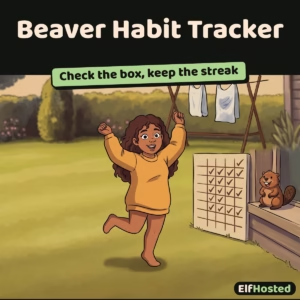
Beaver Habit Tracker
Self-hosted habit tracking, minus the "Goals" gamification — just check the box, build the streak, own your data.
A managed instance of Beaver Habit Tracker on ElfHosted — a deliberately minimal habit tracker with no goal-setting wizardry, no upsell screens, and no analytics shipped to anyone but you. Tick habits off daily, watch streaks build, install as a PWA on iOS/Android. AGPL-3.0, your data stays in your storage.

Reviews
Clear filtersThere are no reviews yet.